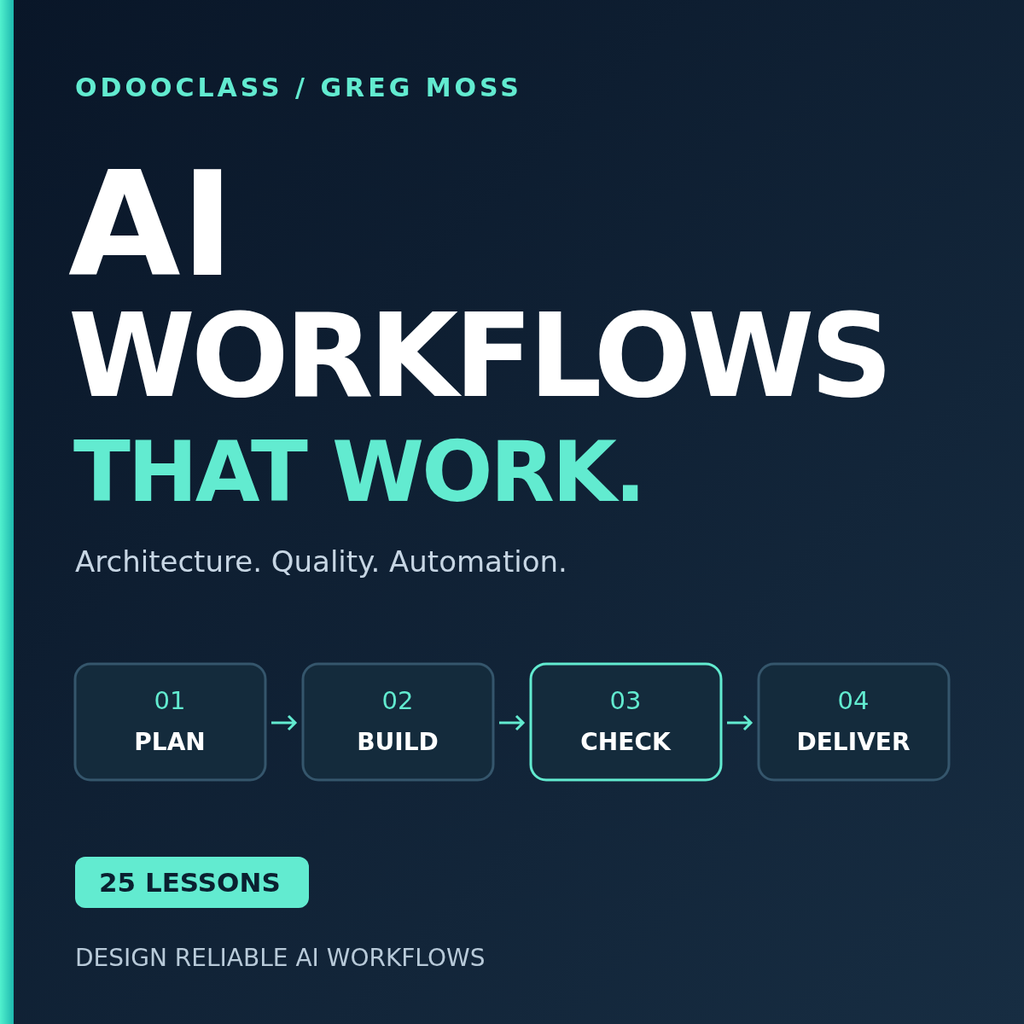
Design Reliable AI Workflows
A practical course for non-programmers, business owners, architects, and developers who want AI systems with clear data, boundaries, quality checks, and recovery rules instead of relying on prompts alone.
Architecture, Quality & Continuous Improvement · with Greg Moss
AI output is not the same as a reliable workflow
Many teams discover the same problem the hard way: a model can produce impressive text, code, images, or plans, but the project still breaks when real work begins. The missing piece is not usually a better prompt. It is the design around the prompt. Reliable AI work depends on clear inputs, owned data, boundaries between decisions and execution, quality checks, recovery rules, and honest evidence of what happened.
Design Reliable AI Workflows: Architecture, Quality & Continuous Improvement teaches you how to think about AI systems as managed delivery systems rather than isolated chats. The course is written for people who want practical clarity without unnecessary jargon: business owners, non-programmers, emerging architects, and developers who need stronger system design. The core position is simple: AI can generate code and content, but you still need to specify the data, the rules, the limits, and what to do when reality disagrees with the plan.
What you will be able to do
- Separate a good-looking model response from a deliverable that can be checked, approved, and published.
- Define workflow boundaries: what AI decides, what people approve, and what the system must verify independently.
- Design data-driven workflows so policies and customer choices live in data instead of being buried in code.
- Model jobs, attempts, artifacts, retries, and release evidence in a way you can explain to others.
- Set quality gates before generation, including deterministic checks, human review, and explicit unknowns.
- Recover safely from failed calls, timeouts, partial success, spend limits, and blocked publication steps.
- Improve a workflow honestly with evidence instead of vague claims about automation.
The five sections
1. See the whole system
You begin by stepping back from prompt craft and looking at the complete delivery chain. Using a song-to-video production workflow as a concrete example, you will distinguish a model response from a managed project, map capabilities versus execution versus evidence, trace six connected subsystems, and build your first workflow blueprint before any code is written.
2. Make workflows data-driven
Next, you learn why data should drive choices while code performs reusable work. The lessons explain tables, rows, keys, relationships, normalization, context layers, and transformable templates in plain language. You will see how to keep customer-specific choices, private facts, and reusable strategy separate so one processor can support many valid variations without becoming a mess of hardcoded exceptions.
3. Build reliable components
Section three focuses on design boundaries. You will define contracts and interfaces, separate processors from vendor adapters, recognize practical patterns such as Strategy, Adapter, Command, Repository, and Pipeline, and apply SOLID principles in everyday terms. The goal is not abstract theory. It is to ask AI to implement designs you can verify because the interfaces, negative cases, and success conditions are already clear.
4. Control quality and recovery
This section turns reliability into concrete operating rules. You will learn how to define quality before generation, distinguish hard failures from weak averages, reason about jobs and attempts, use retries safely, preserve idempotency, and improve processes without misleading yourself. Budget limits, spend controls, security boundaries, and human approval are treated as part of the architecture, not afterthoughts.
5. Build and extend your own workflow
The final section brings everything together. You will model a multilingual video factory, orchestrate jobs while preserving lineage, prove quality before release, and then transfer the same principles to courses, documents, and business workflows. The point is not to copy one house style. It is to design your own approach with a defensible structure and evidence trail.
Capstone: from model to release-ready workflow
Across the final section, you will work through a capstone that models data, coordinates execution, tracks accepted artifacts, and proves release readiness. The capstone uses a worked multimedia pipeline because it makes boundaries visible: immutable sources, parallel generation, quality gates, approval, upload uncertainty, and public verification. By the end, you should be able to sketch a small but serious workflow for your own domain and explain why each part belongs there.
Who this suits and who it does not
This course suits business owners who are evaluating AI operations, non-programmers who need a clear mental model, developers who want better architecture around AI features, and emerging solution architects who need framework-independent principles.
It does not suit someone looking for a promise of instant automation, guaranteed business results, or a no-thinking shortcut to production systems.
It also does not replace the engineering work required to build a production implementation with real tools, integrations, and operational constraints.
What is included
- 25 written lessons with exercises and checks
- Over 3 hours of narrated diagrams in English
- English SRT captions
- A student handbook
- A practical workbook
- Editable planning templates
- Framework-independent teaching with Factory Line and animated music-video examples
FAQ
Do I need coding experience? No coding experience is required to follow the course. You can understand the models, boundaries, and design principles without being a programmer.
Will this teach me one specific software stack? No. The principles are framework-independent so you can apply them in your own environment.
Do I have to adopt Factory Line? No. Factory Line is used as a worked example. The goal is to help you design your own approach, not force a single implementation style.
What kind of outcome should I expect? You should expect stronger judgment about architecture, data, quality, and recovery. Building a production system will still require engineering and tool choices.
Is this only about video workflows? No. Video is used because it makes dependencies and quality gates easy to see, but the same design ideas transfer to courses, documents, and business processes.
What does the package include? The package includes 25 lessons, narrated diagrams totaling over 3 hours, English captions, a handbook, a workbook, and editable planning templates.
Does this include a software platform or API credits?
This is an educational course. A Factory Line software license, third-party subscriptions, API credits, and consulting services are not included. You can complete the architecture exercises without buying model credits.